Tanja

Anyone that’s walked through the corridors of WTC Schiphol Airport has almost certainly seen her: Tanja. A friendly smile, a greeting, a wave. Her presence is warm and familiar. She knows almost everyone, and almost everyone knows her. But behind that open, bright appearance lies a life story that began in a completely different world from the one she walks through today.

From Narva to the Netherlands: a childhood in transition

Tanja, officially Tatjana, was born in 1976 in Narva, a military city in what was then the Soviet Union and is now Estonia. She grew up in a time when borders were closed and identity was something defined by the system. She lived through the Soviet years, but also the momentous shift that followed: the Estonian independence of 1991.

During the famous “For Our Freedom” referendum, more than two million people formed a human chain stretching almost 600 kilometers, from Estonia to Lithuania. “My mother was part of it,” Tanja says proudly. “It even crossed borders.”

Stamps, passports, and the search for identity

Freedom brought new challenges. Estonia began building its own identity, and heritage suddenly became a defining factor. “We were labeled as Russian,” Tanja says. “I received what they called an alien passport. Imagine: you’re born in your own country, but officially you are nothing.”

That document still exists, and her mother still has one. “You pay almost 75 euros for something that tells you you have no nationality.” Because Tanja’s grandfather was Russian, she even had to take an exam to be allowed to keep her Estonian nationality. “Otherwise I would have had to go to Russia,” she says matter-of-factly.

Yet she looks back with nuance. “The Soviet period wasn’t bad for me. My mother worked hard, but we had what we needed.” True discrimination only came after the collapse of the union. She speaks fondly about her childhood: playing outside, adventures, no mobile phones. “We were never at home,” she says with a smile. Now, Estonia is a leader in IT: voting through an app, digital ID cards, life is sometimes easier there than in the Netherlands. Still, she misses the time when children could truly be children.

The choices that shape you

In 1991, Tanja was fifteen, ready to take her next step toward university. But life took a different turn. “I had my son,” she says. She chose her family and responsibility. Her plan to study to become an interpreter had to wait.

When the economic crisis hit and unemployment rose, many Estonians decided to seek opportunities elsewhere. Tanja reached a decisive moment too. “We sat at the table thinking: we want to eat and pay the bills, so something has to change.” She decided to leave for the Netherlands on her own. Her son was 10, her daughter 8. “My son told me: Mom, try it. If it works, we’ll come after you.” The children stayed with their grandmother, and they kept in touch through the internet.
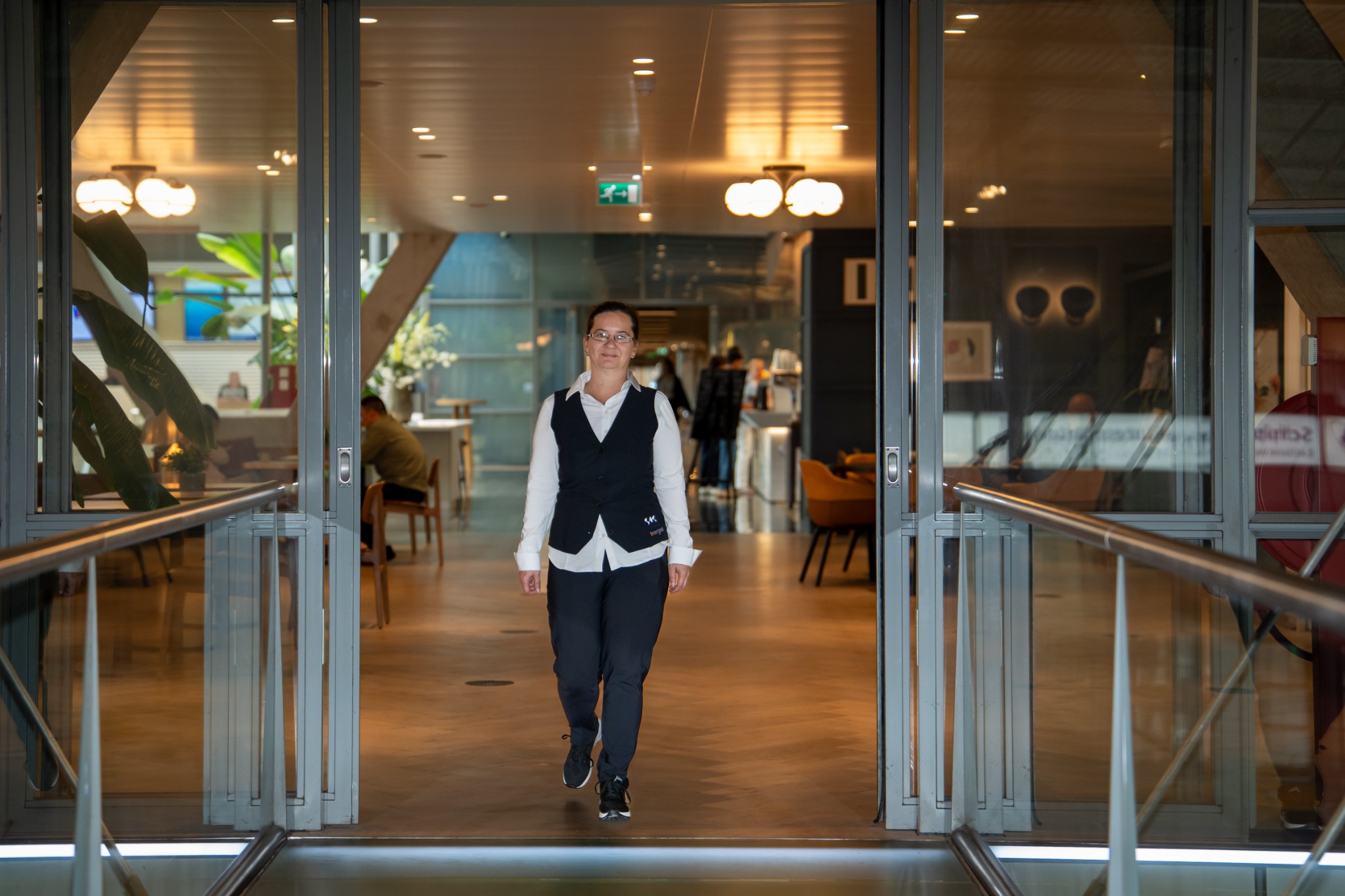
“My son told me: Mom, try it. If it works, we’ll come after you.”

Twenty years connected to WTC Schiphol Airport

In 2006, Tanja found her way to Schiphol. She learned Dutch thanks to helpful people who supported her step by step. “The Dutch helped me a lot,” she says. “I wouldn’t have made it without them.”

She started on the early-morning cleaning crew, earned a permanent contract, completed her supervisor training, became a mobile site manager and later even a trainer.
Always with the same attitude: dedication, heart, and humor. “I enjoy it!” she says often, and you can hear she means it.

Over the years she received plenty of offers to work elsewhere, but she stayed loyal. “WTC is mine!” she says with pride. She knows every company in the building, and they know her. Sometimes she runs into tenants in the city: “They ask how I’m doing. That’s what makes this work so nice.” And thanks to her language skills, she often helped tenants with translations in the past.

Two dogs and two homelands

At home her little pack awaits her: two Pomeranians, soon to be three. “I love big dogs, but that doesn’t work in Amsterdam. So I have three small ones; you can take them everywhere.” The contrast with her childhood is huge. At her grandmother’s house, a mix between a wolf and a German shepherd guarded the garden. “We never closed the door there. Here in the Netherlands, you always do.”

There are things she misses from Estonia: the white nights, the northern lights, the snow (though not in the Netherlands because everything shuts down at the slightest snowfall here here). “I have two homes,” she says. “Estonia and the Netherlands. I love my country, and I love the Netherlands too.”

The source of her strength

What motivates her every day? Her children and granddaughter, with blond hair and blue eyes. They give her direction, strength, and calm. One moment she will never forget happened on a mountain in Slovakia. Tanja was struggling with the climb when her granddaughter said: “Grandma, you always say women are strong, so we can do this!” A small sentence, with an enormous truth.

Between all these worlds, WTC Schiphol Airport, Amsterdam, Estonia, the Netherlands, stands Tanja. Warm. Visible. Steady. She started here almost twenty years ago, and she never left. Not because she had to, but because it felt right. And if you ask what advice she gives new colleagues, her answer is as simple as it is true:

“You have to stay yourself. That is the strongest thing you have.”