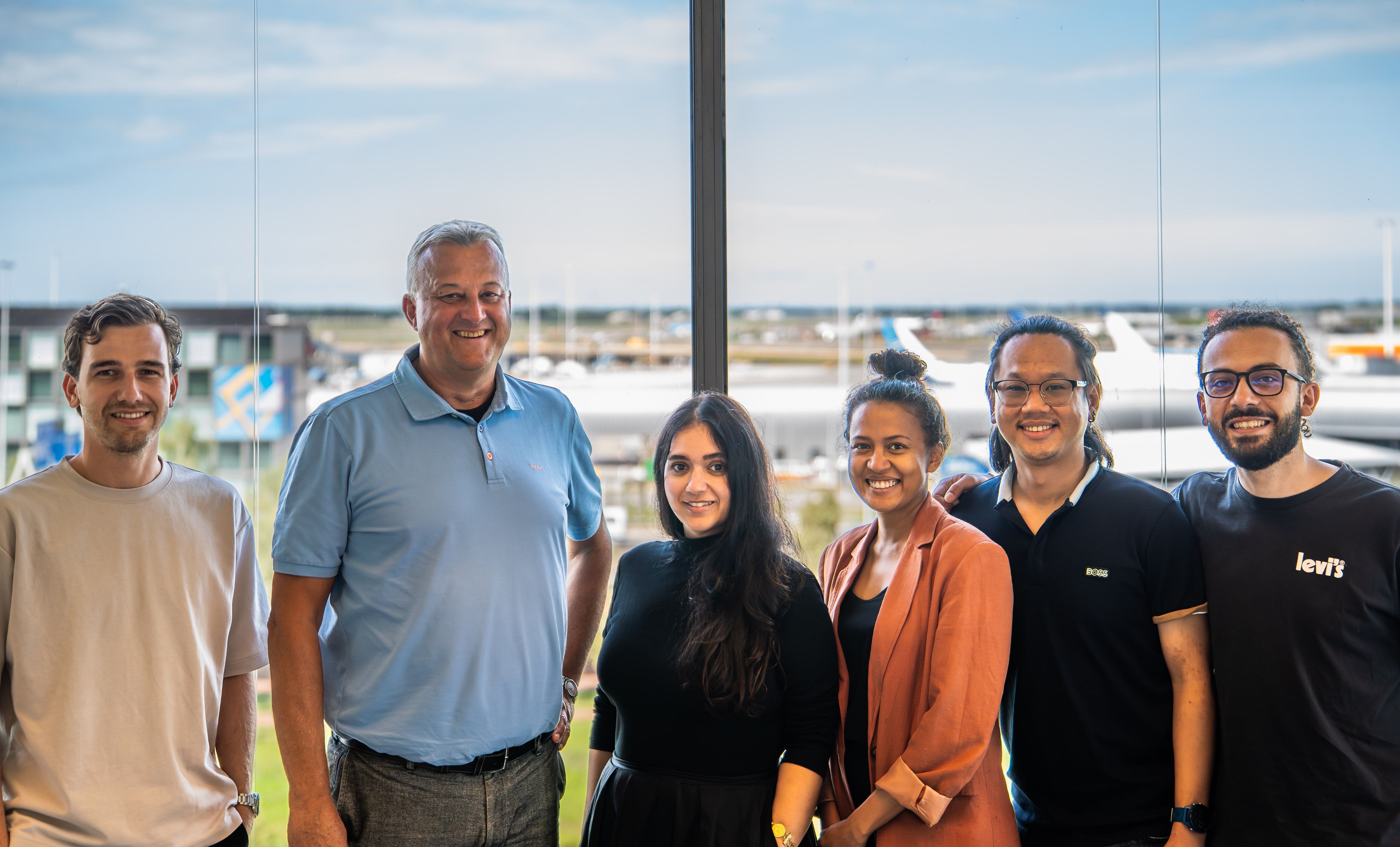
From Rotterdam to Hoorn
Bert was born in 1962 in Rotterdam, not because the family lived there, but because his father happened to be running an Albert Heijn store in the city at the time. Most of his childhood unfolded “wherever his father had his store”: first in Amstelveen, later in Venhuizen, the agricultural village between Hoorn and Enkhuizen. As the youngest by far, with two much older brothers, he jokes: “I sometimes say I had three fathers.” His youth was warm and filled with sports. Tennis and later skiing, never with perfect technique, but always with character. “Rolling up your sleeves gets you further than you think.” And anyone who talks to him longer will quickly encounter another lifelong loyalty: Feyenoord. “You don’t support them for fun,” he jokes, “but that mentality of going all in just really fits me.”
A career spanning four decades: a second‑generation Albert Heijner
His Cito test results predicted it already: future Albert Heijn store manager. Though in high school he briefly flirted with the idea of becoming a veterinarian. He chose a science track, failed miserably (“all fours and fives”), listened to his mother, switched back to a general track, passed his exams, and eventually still found his way to Albert Heijn. He stayed for 41 years, holding roles ranging from supermarket manager and regional manager to dairy and bakery assortment manager. In 1998, he introduced the Bonuskaart and helped develop the first six XL stores.
Later, his work shifted to European sourcing within Ahold, together with ICA in Scandinavia. And then, in 2009, came the question: would he join AMS Sourcing? It was supposed to be temporary. He never went back. “That really says enough about how great this environment is.”
What AMS Sourcing does: small team, big impact
AMS Sourcing purchases private‑label products for all member supermarket chains. Everything with a shelf life of ten days or longer falls under their responsibility: packaged cheese, yogurt, desserts, pre‑packed meats, 95 product groups in total.
The concept is powerful in its simplicity: combine all volumes from the shareholders and present them to the market as one large order. The impact is significant. “In food retail, every cent matters,” Bert says. “Supermarkets operate on an average net margin of around four percent. So a one‑cent savings in purchasing? That’s a lot of money.”
AMS Sourcing achieves this with a relatively small team of nearly fifty people, representing 21 nationalities, sourcing billions’ worth of private label annually. Since January, they also source for a major Canadian retailer, a trajectory conceived and executed entirely within AMS Sourcing.
Why WTC Schiphol Airport
AMS once operated from Zaandam. Convenient in terms of distance, less so in terms of perception. Other members sometimes saw AMS Sourcing as an extension of Albert Heijn. At WTC Schiphol Airport, the organization stands neutrally in the middle of the playing field, accessible to all member chains.
And practically? Unbeatable. Bert can fly to Stockholm at 07:00, be in a meeting at 10:00, and be home for dinner that same evening. The building itself has undergone a visible transformation in recent years: the bright reception area at the top of the escalator, Fortune Bar to the left, Stach and Juliet’s Kitchen within reach. “It’s a place that works,” he says. “And people genuinely like it when you tell them you work at Schiphol.”
Tasting, talking, pricing
At AMS Sourcing there is one golden rule: private label must be at least as good as the A‑brand and preferably about 30% cheaper. That process begins in their own kitchen. “There we stand with ten people around the table,” Bert explains. Bowls, plates, blind tastings. Then the products are sent to the member chains, who test them internally or through consumer panels. Only products that score equally or better than A‑brands make the cut.
Covid, war, and staying flexible
Until 2020, AMS Sourcing usually worked with annual contracts. Then came the Covid pandemic, followed by the invasion of Ukraine. “Suddenly, availability was the big theme. Availability, delivery times, raw material prices, everything became volatile.” Contracts required new clauses, prices had to be renegotiated mid‑term. Work routines also changed. “We used to be in the office five days a week. Then everything shifted.” Working from home became normal. Trust became central. People started spreading their hours, answering emails in the evening. “It has made us more modern,” Bert says. “And it keeps turnover low. People value that freedom.”
The power of culture
Bert strongly values a culture where everyone feels free to express their true opinions. “I don’t like yes‑men,” he says. “You’re stronger as a team when everyone feels safe to speak their mind.” The management team collaborates intensively with the member retailers on strategy, reporting, new suppliers, savings, and communication. There are monthly video calls and three to four in‑person meetings per year, now rotating among member locations such as Stockholm and Helsinki. Meanwhile, the atmosphere remains human. “When I joined we were about twenty; now almost fifty. But the culture is still approachable and without heavy hierarchy.”
At home: cooking, golf, and a gentle giant
Bert stands 1.91 meters tall, broadly built, but with a “very small heart,” as he says himself. “People don’t always expect that.” Despite tough negotiations and multimillion‑euro contracts, he can be emotional and sensitive. He finds his relaxation in cooking, being a member of two cooking clubs in Hoorn. In winter they cook together six times in a restaurant; in another club four people cook while eight join the table. His love of food even comes alive at the office: “Colleagues often bring their favorite dishes from home. With our Asian colleagues you will then automatically get an amazing lunch.”
On Sunday mornings he golfs with friends (“my wife is much better than I am”), and on Saturday afternoon there’s the fixed drinks and bites in Hoorn from four to six.
Values, joy at work, and the generation after him
Bert and his wife Petra have been happily married for 30 years. Their children chose their own paths: ICT, Creative Business, and police academy. Exciting as a parent, but essential for the children, he says: “Do what you enjoy. You’re awake for sixteen hours a day. Half of that you’ll spend at work. You should enjoy it.” His values are steady and strong: integrity, honesty, not lying, doing what you promise. “Anything you put real effort into becomes more achievable than you expect. Sometimes you surprise yourself.” To newcomers, he gives one piece of advice: develop broadly, don’t specialize too quickly, don’t focus only on money, and keep your learning curve steep.
Later is now
Bert has no bucket list. No dream for “later.” “I’ve seen too many people postpone things that ultimately never happened because of illness or worse. Later is now. You only live once. If you want to do something, then you have to do it now.”